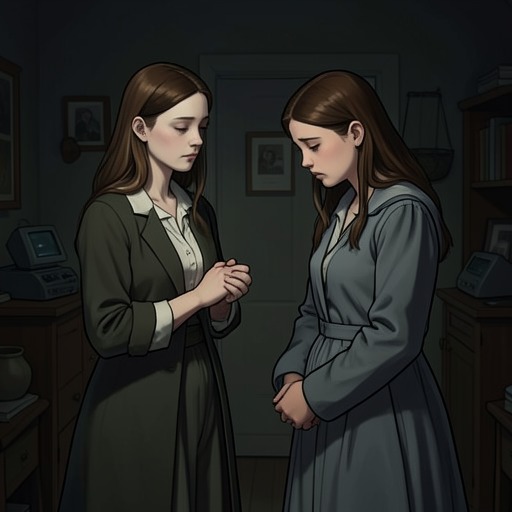
Kathy and Laura
Never Let Me GoKathy and Laura’s friendship joins the intimacy of their years at The Cottages to a later, more fragile connection formed through separation, carer work, and the closing of Hailsham. Their reunion after seven years shows both how much has changed and what remains shared: a history that neither can easily bring themselves to discuss, but that returns with force when they finally name the place they have lost.
Friendship at The Cottages
Kathy remembers Laura as one of her closest friends, though the surviving scenes offer glimpses rather than a continuous account of their early friendship. One such glimpse comes when they watch Keffers from Kathy’s room. After gathering six or seven pornographic magazines, he storms toward his van and leaves the magazines on bricks outside the boiler hut. Kathy has been laughing at something Laura said; when Keffers drives away without retrieving them, Laura observes that he will have to collect them again the next time he conducts a purge. Her dry comment turns his fury into a joke between the two girls. Later, Kathy picks up the magazines and carries them inside the boiler hut, wary that taking them to her room would invite teasing and that no one would understand her reasons. Laura’s presence in the scene places her inside the ordinary shared world of observation, jokes, and unspoken distinctions that Kathy recalls from their school years.
That shared past matters to Kathy beyond the memory of particular incidents. As a carer, she says, the work becomes harder without a deeper link to a donor, and choosing people from her own past helped her get close again to Ruth and Tommy. She came to seek out people she remembered, especially those from Hailsham. This is part of the wider emotional landscape in which Kathy and Laura’s friendship persists, though the reunion itself is not a caregiving arrangement between them: by the time they meet again, both are carers, and the conversation reveals how taxing that work can be.
The chance reunion
Kathy and Laura meet at a service station after they have not seen each other since The Cottages seven years earlier. Kathy first spots Laura sitting vacantly behind the wheel of a parked car, looking toward the motorway. For a moment she considers walking past. The impulse unsettles her because Laura had once been among her closest friends; Kathy also senses that Laura has become the kind of exhausted carer she has just been describing and does not want to discover more about it. She nevertheless crosses the car park and taps on the window.
Laura is in a shapeless blue anorak, her hair cut much shorter than Kathy remembers. She does not seem startled by Kathy’s arrival. Instead, she opens the door, and the two talk for about twenty minutes, until Kathy has to leave. Laura speaks quickly about her own difficulties: she is exhausted, has a difficult donor, and loathes particular nurses and doctors. Kathy waits for the old Laura’s mischievous grin and wisecrack, but neither appears. Laura seems glad to see her, yet Kathy has the impression that what matters most is having someone there to listen, whoever that person might have been. Their meeting offers companionship, but it also exposes the distance between the friend Kathy remembers and the tired woman before her.
What the conversation can and cannot reach
For a long while, the two avoid discussing their earlier life. Kathy suspects that both sense something dangerous in opening the subject: their shared past is close, but not readily accessible through casual reminiscence. They eventually talk about Ruth, whom Laura had encountered at a clinic a few years earlier while Ruth was still a carer. Kathy tries to draw Laura out about that meeting, but Laura is reticent. Kathy presses her to say more, and Laura briefly seems on the verge of answering with one of her old wisecracks; the expression fades, and she returns to looking tired. The familiar humor survives as an expectation, not as an easy recovery.
The conversation changes when Kathy reaches for the car door and says they will have to talk again another time. Both appear aware that leaving without addressing what has been avoided would feel wrong. Laura finally says, “It’s weird. Thinking it’s all gone now.” Kathy answers that it is strange and hard to believe it is no longer there; Laura adds that, although the loss should not make a difference to her now, somehow it does. The closing of Hailsham, rather than a detailed account of their friendship, becomes the point at which they can speak together plainly. Their spontaneous embrace affirms that the school remains present in both their memories. It is not described as an attempt simply to comfort Laura or Kathy, but as a way of affirming their shared past.
Separation, memory, and change
Kathy had heard rumors of Hailsham’s closure before meeting Laura. When a former student told her that the house and grounds might be sold to a hotel chain, Kathy’s first concern was not only for the younger students still there: she thought of all the former students, now scattered across the country as carers and donors, who remained linked by where they had grown up. The news left her imagining that the bonds among them could be cut, like balloon strings severed where they were gathered together. It also made her feel that things she had assumed could wait might soon have to be done or abandoned. In that context, Laura’s earlier suggestion that Kathy become Ruth’s carer struck with particular force, even though Kathy had resisted it at the time.
Their reunion gives that larger fear a personal shape. Kathy and Laura do not rebuild their former friendship through a long exchange about childhood; instead, a brief admission about Hailsham brings them close after the strained talk about present-day work. The embrace confirms a connection without erasing the intervening years, Laura’s exhaustion, or the gaps in what they tell one another. Kathy later insists that the memories she values most will not fade, and names Ruth and Tommy among those she has lost. She does not specifically include Laura in that statement, but the car-park encounter has already shown how a shared place can preserve a bond: Hailsham is gone as a physical home, yet still available to both women as something they can recognize in each other.